


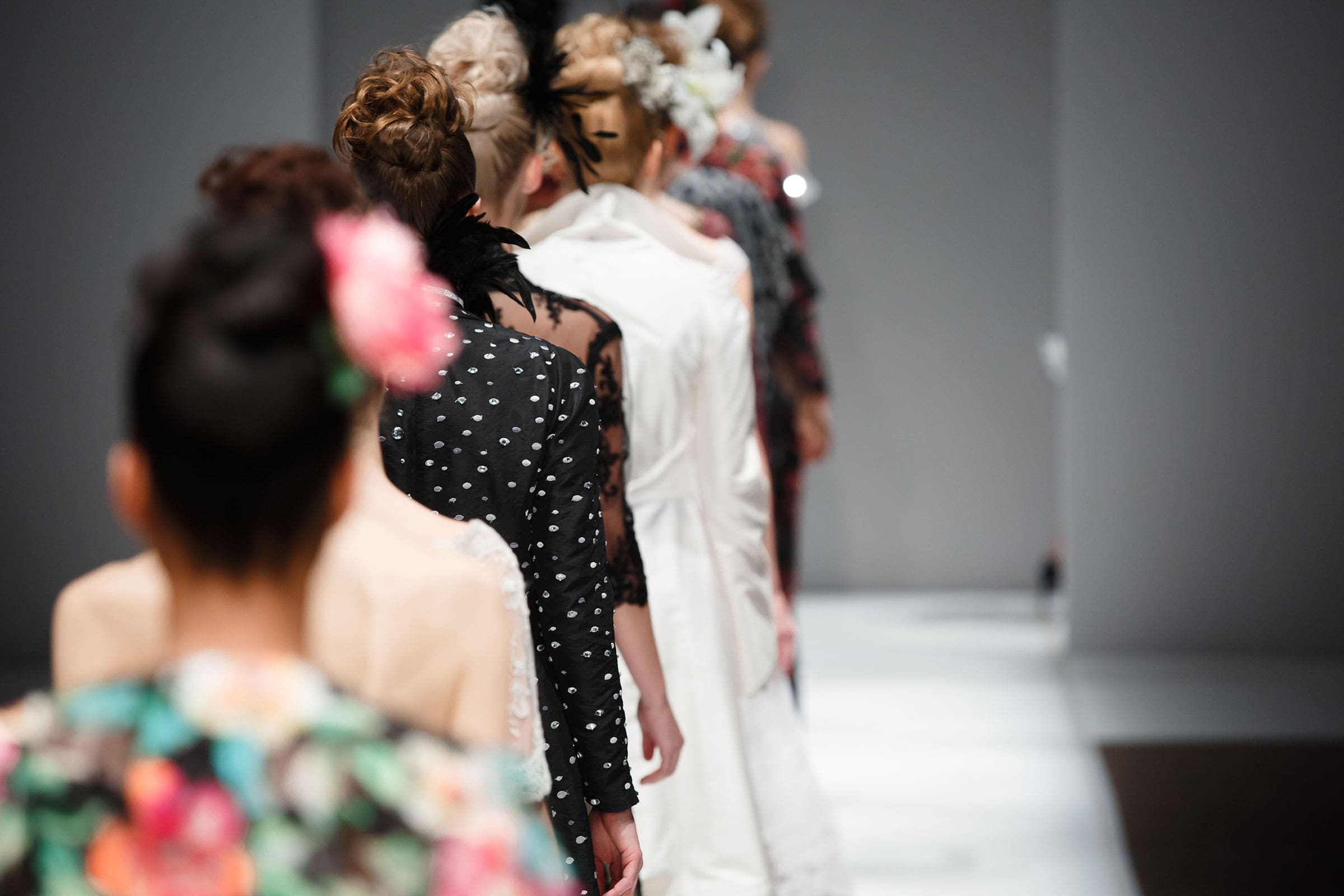
An editorial study of clothes that reveal themselves as you walk away.
An open back beneath a severe neckline. A line of buttons disappearing toward the waist. A coat whose volume only becomes visible in motion. Some of fashion’s most compelling details arrive after the introduction.
The first photograph is taken from behind.
A woman stands at the edge of a doorway in a black dress. From the front, the dress is almost reserved: high neckline, long sleeves, no embellishment. From this angle, an opening exposes the back, framed by two precise edges of fabric. A narrow tie rests at the nape of her neck.
Her hair is lifted. There is no necklace.
Everything the image needs is already there.
Fashion photography often begins with a face and a frontal silhouette. Turn the subject around, and a different set of details becomes available: the fall of a collar, the placement of a seam, the space between cloth and skin. Even familiar garments can become difficult to identify immediately. The eye has to linger.
A different kind of exposure
An open back changes the balance of a dress.
With a high neckline and a long hem, it concentrates exposure in one place. The effect depends on the surrounding fabric: how closely it follows the shoulders, where the opening ends, whether its edges lie flat or move away from the body.
For this story, the styling stays spare. A black column dress, low shoes, a single cuff. In one frame, a fine knit is carried over the forearm. In another, it is drawn across the shoulders, concealing part of the opening.
The photographs alternate between coverage and revelation. A small movement changes the composition.
Fit becomes especially visible here. A neckline that shifts or an edge that gapes can interrupt the intended line. The dress needs to be photographed walking, sitting, and turning—not simply arranged for a still pose.
The architecture of a coat
The second look is a generously cut trench, its belt loosely tied behind the waist.
Seen from the front, the coat hangs open. From behind, the knot gathers the fabric into folds, drawing attention to the back panel and the volume below it. The sleeves are pushed up just enough to expose the wrists.
Underneath: a pale shirt, dark trousers, and shoes with a clean, elongated shape.
The camera stays low as the wearer crosses the frame. At each step, the coat opens around the legs. A rear vent, barely noticeable while standing, becomes part of the silhouette in motion.
This is where the photograph needs patience. The strongest frame may fall between poses, when one heel is lifted and the coat has not yet settled.
Turn the jewelry around
For the final look, a fine chain is fastened so that its pendant falls down the back of a deliberately chosen, reversible top.
The chain traces a small vertical line between the shoulder blades. Against matte fabric, its movement catches the light without requiring another accessory.
A low bun keeps the neckline visible. The trousers are softly tailored, their hem meeting a flat sandal. Nothing else competes with the chain.
The detail is intimate enough that a distant photograph might miss it. The sequence needs a closer frame: the clasp, the fabric’s texture, the pendant resting slightly off-center after a turn.
Leave before the photograph ends
The closing image returns to the doorway.
This time, the subject is already moving through it. A shoulder has slipped out of view. The dress remains visible for another fraction of a second, its back opening held within the dark outline of the fabric.
There is no final pose.
Just enough of the garment remains in the frame to make you want another look.